

WSH Month Special: Safety Starts With Us
- September 30, 2026
- Humans Of CPG FM
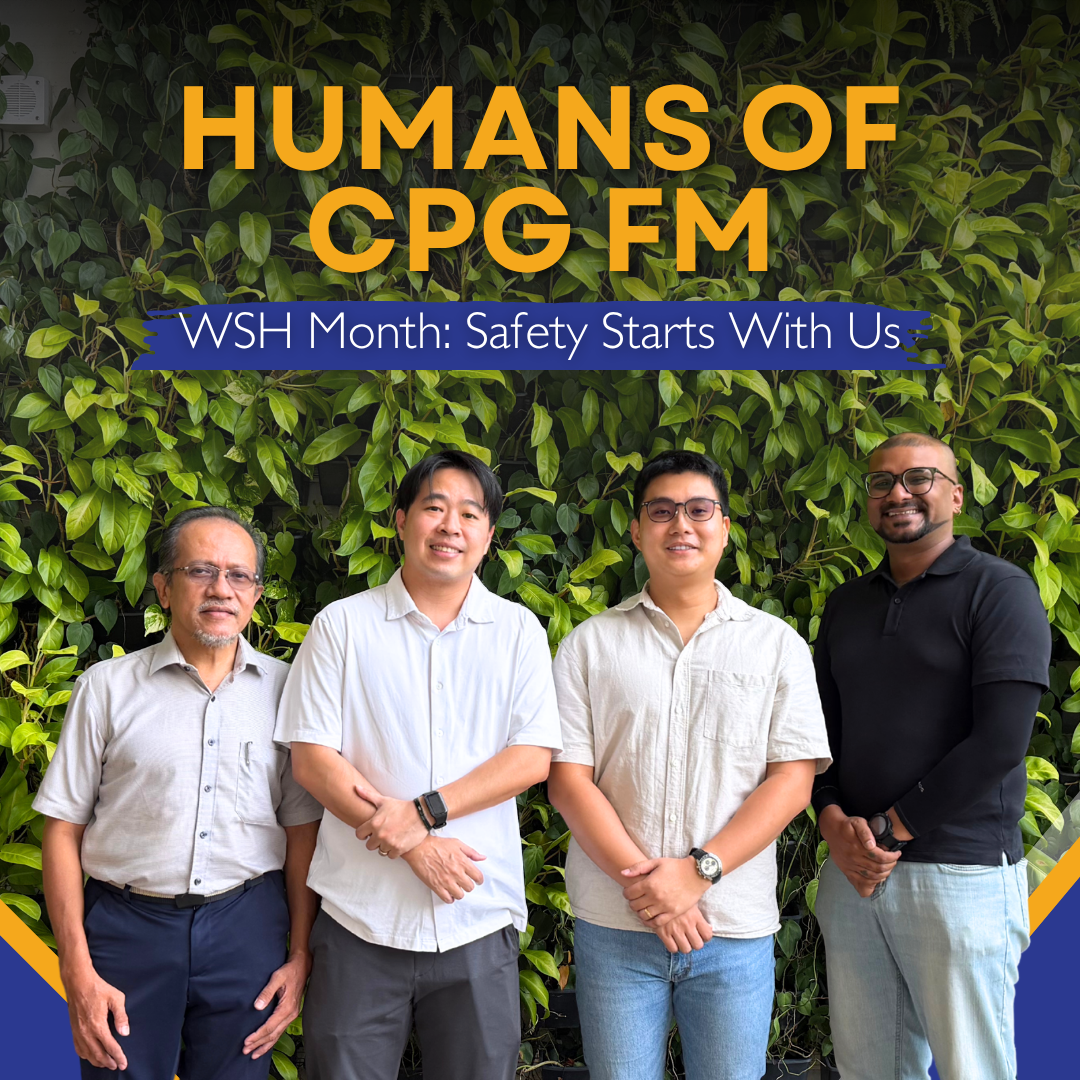
In Facilities Management, Workplace Safety and Health (WSH) shapes the everyday decisions that keep operations running smoothly, from planning work and identifying risks to managing contractors and responding when something does not look right.
This WSH Month, we take a closer look at the people helping to strengthen this culture across CPG FM. Meet Calvin, Rosly, Josh and Sanjay, four colleagues working across different areas of WSH. From setting organisation-wide standards to inspections, Permit-to-Work (PTW) reviews and engagement on the ground, they share what brought them into WSH, what the role looks like day to day, and what it takes to build a stronger culture of safety.
Calvin Lee
Senior Manager, Workplace Safety & Health
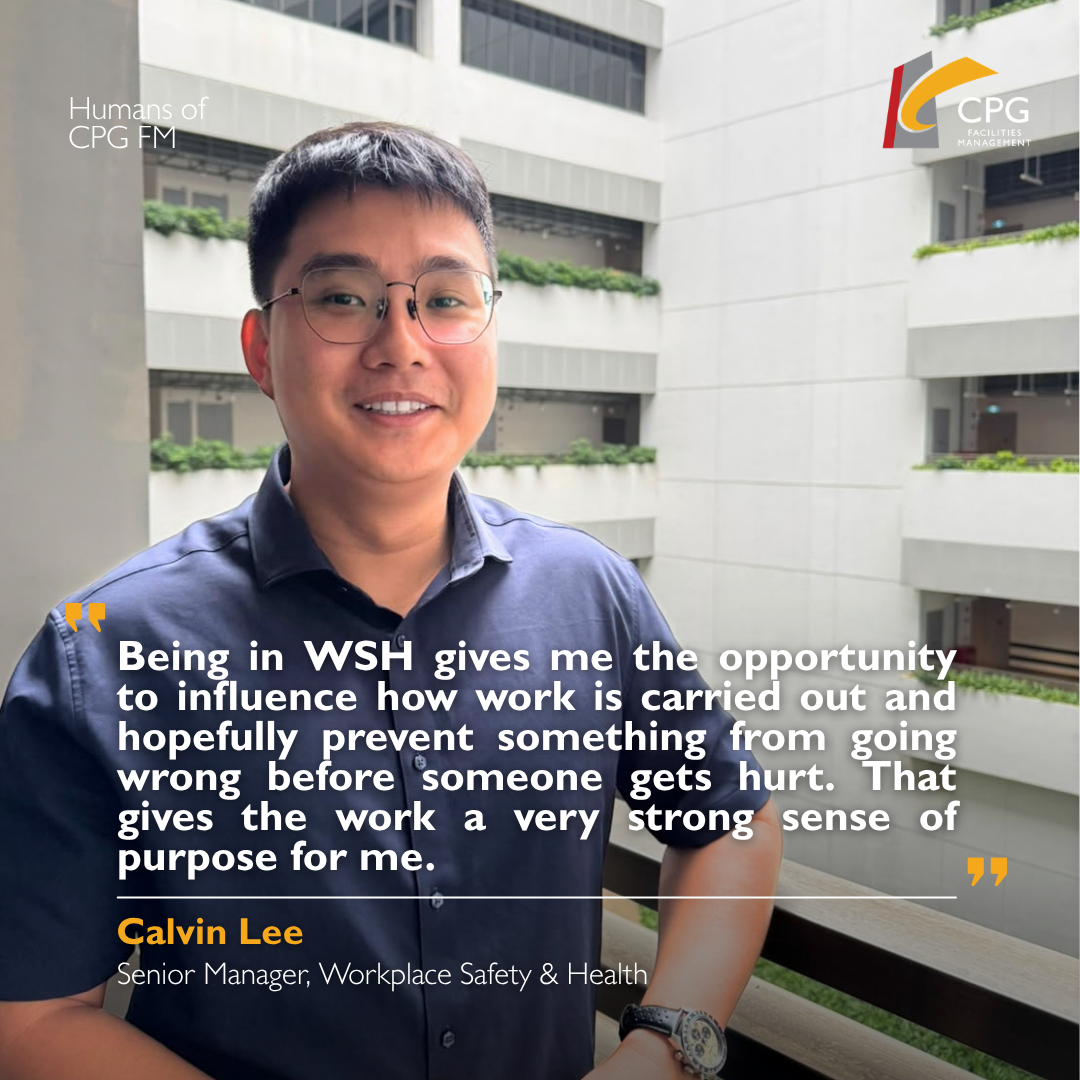
Calvin joined CPG FM more than two years ago from a background in events and special projects, where he coordinated multiple teams and suppliers under conditions that could change quickly. He now manages the whole safety team and leads on WSH frameworks and standards at CPG FM. “Every site is different, the operational requirements are dynamic, and there are always new challenges to solve,” he says.
Calvin’s work focuses on setting frameworks and standards that WSH staff across CPG FM can build on, with solutions grounded in the realities and feedback of our site teams. “We regularly engage our site teams to understand their challenges and pain points,” he says. At one site, Calvin and the WSH team worked closely with operations to strengthen safety engagement and encourage greater participation across teams. Through regular engagement, employees became increasingly comfortable raising concerns and contributing to safety initiatives. “Staff are comfortable raising concerns because they understand the objective is not to blame someone, but to identify the problem and make the workplace safer,” he says.
“Good safety should enable work, not prevent it.”
Asked to sum up CPG FM in one sentence, he says: “A place where people are given the opportunity to make meaningful change.”
Rosly Thamby Ahmad
Workplace Safety & Health Officer cum WSH Trainer

Rosly has more than 30 years of experience across construction, oil and petrochemical, and manufacturing. He joined CPG FM in March 2025, treating the move into an unfamiliar industry as a test. “It’s an industry that I have not worked in before,” he says, “and thus when there is opportunity, I took the challenge to prove to myself that I should be able to perform in this industry.”
A typical day for him includes PTW applications, verification inspections, training materials and document reviews, alongside the occasional urgent site visit that reshapes the rest of the day. His approach is straightforward: do not rush the work, use references, and consult the team when needed, an approach shaped by years spent as a MOM-approved Risk Assessment Consultant, WSH Trainer and Auditor. The project he is most proud of at CPG FM is helping launch the organisation’s electronic platform for safety meetings, inspections and e-PTW.
“Treat a workplace like your home, where you want everything in good order and ensure your family’s safety in the environment.”
Rosly sees the role of WSH as supporting teams to carry out their work safely and effectively. His advice for anyone starting out in FM is to learn carefully, speak up when something needs to change, and remember that the work is a team effort.
Josh Lim
Senior Workplace Safety & Health Officer

Josh spent more than 10 years as a WSHO in construction before joining CPG FM in September 2024. The move into Facility Management meant a different kind of safety work. “Instead of focusing mainly on a construction project, FM involves managing safety across many different sites, contractors, work activities and day-to-day operations,” he says. Some days follow a plan of inspections and document reviews; others are reshaped by an urgent issue that needs attention straight away.
Quality, to Josh, means going beyond the paperwork. “When reviewing documents or conducting inspections, I try to understand the actual work being carried out and whether the proposed safety measures are practical and effective on site,” he explains. A continuing focus for Josh is also encouraging everyone on site to take ownership of safety and to raise concerns early when something does not look right.
“Our role is to help people find a safe way to get the work done.”
Since joining CPG FM, Josh has watched processes, contractor management and reporting improve steadily, alongside a wider shift in how people across the organisation think about safety. His advice for anyone considering a career in FM is to stay willing to learn, stay adaptable, and pay attention to more than just your own area of work.
Sanjay Malcolm Mohanan
Senior Workplace Safety & Health Coordinator

Sanjay served six years with the Republic of Singapore Navy before switching into safety work in 2021, starting out in construction. He joined CPG FM in 2025. “My time in the Navy taught me the importance of discipline, teamwork and being aware of the risks around you,” he says of that move.
His day-to-day work covers inspections, PTW verifications and regular conversations with site teams and contractors. At one project, early WSH inspections identified opportunities to strengthen site practices. Through regular site engagement and follow-up, Sanjay saw greater consistency in safety awareness and practices over time.
“Accidents happen in a fraction of a second, and past luck is never a guarantee of future safety.”
The mindset Sanjay would most like to change is the assumption that an accident “won’t happen to me,” or that a process is fine simply because it has always been done that way. What keeps him motivated is knowing his work helps colleagues and contractors get home safely, and that every site brings something new to work through.
Changing the Mindset on the Ground
Across the team, changing safety culture often comes down to changing everyday habits: speaking up when something looks wrong, questioning practices that have become routine, and seeing safety as part of getting the job done well rather than something that gets in the way.
That starts with knowing what to look for. CPG FM runs regular training programmes for its people, then customises the content to each site, so operations staff learn to identify the risks they are most likely to come across in their own work.
The next step is making it easier for employees to speak up. Staff have multiple avenues to raise hazards, unsafe conditions or processes that could be improved, so concerns can be addressed before they develop into incidents. Just as importantly, people need to see that speaking up leads somewhere.
“When employees see that their feedback is heard and leads to actual improvements, it builds trust and encourages more people to speak up,” Calvin says.
He points to one example. At one site, the WSH team reviewed recurring work activities with operations to ensure that the appropriate safety controls were applied according to risk. High-risk activities continue to require a PTW, while lower-risk routine activities are managed through a Work Declaration, together with the applicable risk assessments, safe work procedures and safety documentation.
Over time, that changes the role people see themselves playing in safety. Instead of walking past something that looks wrong or assuming it is someone else’s responsibility, employees are encouraged to flag it, discuss it and help find a safer and more practical way forward.
Backing the People Who Keep Us Safe
That kind of shift needs backing from the top, and CPG FM has built it into how the organisation runs. For serious safety matters, the WSH team has a direct escalation pathway to senior management, including the CEO where required. Senior management also participate in site walks to understand operating conditions firsthand and engage directly with site teams.
The paperwork is changing too. Permit-to-Work applications, inspections and meeting records have moved onto digital platforms, and CPG FM is starting to put that data to work, using it to spot patterns before they turn into incidents rather than only after.
None of this works if people feel isolated in their roles, so CPG FM also invests in bringing teams together, through health-focused events and regular engagement that provides additional opportunities for employees to raise concerns early, complementing CPG FM’s formal safety reporting and escalation channels. Staff are also sent to seminars, courses and industry conventions to keep learning, and given room to grow into bigger responsibilities, the kind of exposure Sanjay credits for broadening his experience since joining: “CPG FM is an organisation that cares for its employees.”
—
Much of good safety work happens before an incident occurs. The inspections, follow-ups and conversations taking place every day help teams identify risks early and keep work moving safely.
When asked where safety starts, Calvin, Rosly, Josh and Sanjay each answered differently:
Calvin: “Safety starts with you.”
Rosly: “Safety starts with being concerned about each other.”
Josh: “Safety starts with each of us.”
Sanjay: “Safety starts with me, but it doesn’t end with me.”
Different answers, but they point to the same idea: safety does not belong to the WSH team alone. It is built through the choices people make, the concerns they raise and the responsibility they take for those around them.
Safety starts with us – that is how workplace safety and health becomes part of the way we work.
——————————
Humans of CPG FM is an ongoing series spotlighting the people who make CPG Facilities Management what it is.
Author: APT.